Fizzy: Just Another Work Management Tool or the Answer?
Project management tools often fail when they try to do too much. This article looks at why Asana stopped working for me, how Fizzy helped me regain focus, and what I learned about managing work without managing the tool.

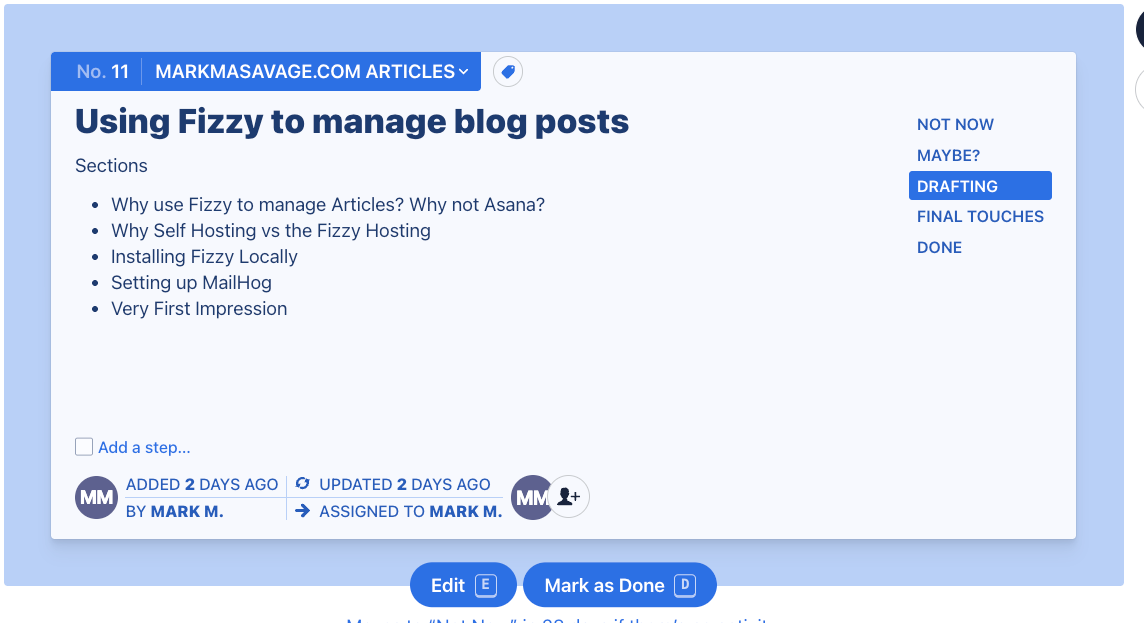
Over the years, I have used many work (project) management tools, and eventually I have discarded all of them for one reason or another. In most cases, they were too much tool (too many features) for my needs, or they became cluttered with too many to-do items.
A few of the work management tools I have used
- Jira
- Trello
- Basecamp
- Monday.com
- Github Project
- Asana
Why Not Asana? Why Fizzy, Now?
Asana, one of my favorite project management tools, started out simple and has become increasingly feature-rich. In its early days, I liked how easy it was to create a task. Click add task, type a name, provide a description, assign it, and then comment as needed. It was so easy to add a task that it became too easy to do so. My Asana account became cluttered with thousands of tasks that were going nowhere. There were things I thought I needed to get done, when actually they were only things that would have been nice to do. The issue was that they just stayed there, in the way, with no activity and no hope of any soon. I could clean them up and move them to a not-now project or lane, but that requires me to review them and make a decision. Extra time spent managing the tool instead of doing the work. And when I have reviewed the tasks in the past, I would almost always default to: "I need to do this!"
Eventually, I abandoned Asana as a task manager and migrated back to a Mole Skin Notebook and a pencil. It was working well until I decided to start writing again and wanted some way to keep track of article ideas. Of course, I could have used a spreadsheet, but...yuck. Fortunately, I started following Jason Fried, co-founder of 37signals, maker of Basecamp, after reading a few of their books, and he began discussing Fizzy, a "modern spin on kanban for tracking just about anything."
At first, I thought, "here we go again", but after watching a 17-minute demonstration of Fizzy led by Jason, my interest started to grow. It actually looked fun and simple, and it provided a back-to-basics vibe. I left it at that for a few weeks while I worked on other, more mission-critical items for Finluency. Every once in a while, I would jump onto Fizzy's website to learn more, and the more I learned, the more interested I became.
My only concern was signing up for another twenty-dollar-a-month subscription; however, unexpectedly, 37singles has removed that roadblock.
Subscription vs Self-Hosting Fizzy: Fizzy's O'Sassy License
Between the interactions with Fried on X, YouTube, and Fizzy's website, I had been exposed enough to the product to sign up. However, I was reluctant to sign up for the 1000 free card trial because I didn't want to have to cancel or commit to a subscription. Twenty dollars a month for a good product is not much, but multiple subscriptions to various services can start to add up. The worst are the ones that get used for a while and then set aside, which has been my experience with project management software. I felt Fizzy would most likely follow the same path as the others, but here is the kicker.
Fizzy uses the O'Sassy License Agreement, which grants free use of the product.
All I needed to do to trial the product without having the pressure of making a decision was install it and run it in a Docker container. In fact, 37signals provides detailed instructions to set up your own self-hosted Fizzy application. This was a no-brainer for me, and with Claude's assistance, I had an instance up and running in less than 20 minutes.
I have a lot of respect for 37signals for offering this frictionless way to try their product, and if it goes well, I will be willing to move to the hosted platform to reduce the time I need to commit to maintaining the application locally.
My First Impressions of Fizzy
Here is my completely honest first impression of Fizzy.
I have to admit, I had fairly high expectations after debating if I wanted to even try the application for three weeks before giving it a shot. I had enough interactions with the product that I had built my hopes up fairly high, and I was expecting an entertaining, fun, novel experience.
My initial impression did not meet those expectations. Fizzy was not as intuitive as I had dreamed it would be, and I was about to discard it until I walked through the playground tutorial.
The onboarding process brought clarity as it walked through editing, creating, and moving tasks across the Kanban lanes. The more I played around, the more I understood the design decision behind the application. The direct identification of keyboard shortcuts on the interface simplified its use, and the focus card view directed my attention to the work at hand. Personally, I enjoy the card's blue hue. It's calming, which increases my focus on the task.
At the end of the day, even though I did not get the theme park experience I was expecting, Fizzy's initial release has been a good experience for me. I plan to continue using it to manage article ideas and, if everything goes well, integrate it into a broader role at Finluency.